biginabox
The container for the thing contained.
When We Were Small
From the little person’s viewpoint.
It’s almost certain that altering the scale of different elements in a composition alters the mood of it. Size matters. The urban environment is generally more intimidating to children than to adults.
So does the device of photographing from the height of a child impart some of its vulnerability, and therefore depict the city as intimidating as it really is to them?
‘I hear Thy gentle voice, calling unto me.’
Trelech. Sir Caerfyrddin. 19/2/2013
Recently, an old friend of mine died. A farmer and farmer’s daughter, this is a little record of the place and culture in which her gentleness grew.
Mi Glywaf Dyner Lais.
Stargardt Vision – Understanding the World
Jan Bölsche, born 1973, works as photographer and author in Berlin, Germany. His photos have been published in newspapers, magazines, travel guides, catalogs and on websites and CD covers. He specializes in capturing the Decisive Moment.
Controlled by a defect gene, the cells of Jan Bölsche’s retina started to slowly fade away in his early adolescence. In an still ongoing process, a growing blurry and nebulous spot in the center of his field of vision covers objects he tries to bring into focus. This medical condition is called “Stargardt’s disease” or Juvenile Macula Degeneration (JMD). His sensation of color is also quite different.
I met him in a cold Greenwich to talk over how he works, and the state of photography now.
How did you start taking pictures?
I wish someone had told me about photography. I always had a strong interest in the visual arts, but when this eye thing happened to me, I was desperate because I had the feeling, it’s over now. So I focussed on my computer interests.
Then a friend pointed out that a digital camera could be useful to me as a reading aid. Then I discovered it was a good way to read distant street signs and so on. So I would take a picture and read. It became a navigation tool. Which gave me more independence rather than having to ask for help 1000 times a day.
So you began by literally using photography to understand the world… How did you develop?
On Flickr. Flickr is the 2nd ingredient which brought me to photography. Which gave me another reason to leave the house and bring something back.
I had a challenge with a friend on Flickr to get the best picture on a specific subject. We lived far apart but could exchange images and criticisms online. That’s what it’s all about. Finding like-minded people you can learn from.
And those who aren’t as like-minded?
‘Doesn’t happen very often. Most comments are almost exclusively positive.’
So what about the debate about the continued preference for monochrome?
Some would say the whole BW ‘look’ is merely due to the failings of the medium.
I agree. What I try to do is make something interesting and make a point about something. And so I tend to put emphasis on what I want the viewer to see, and a yellow plastic bag can be a distraction. And so I get rid of it…
Telling a story is what I want to do. Pushing a button that starts a thought process which has an open ending. An image which makes you think about the situation you are in.
How much do you sense the change in personal space, and the need to ask consent? Is there a new relationship between people and photographers when everyone is a photographer? A need to negotiate the space and moment.
How to deal with this dilemma. As a photographer I want to capture a moment which would be destroyed if I asked permission. I Like to run around cities and have to find situations that are special in that they last only a few seconds. Interactions. Might be an advertisement, a person yelling, and in the background a graveyard.
But isn’t a moment of consent just another moment, and as valid?
But the situation I’m interested in – I don’t want them to become aware that they are part of some interesting scenery. Their behaviour would change. At worst, they would start posing. Often it is about non-awareness of them interacting with their background or with someone else. So I can’t really point that out. So if you care for your personal rights You have to tell them afterwards.
The Creuzberg street market shot seems to embody your condition, with the dynamic details swirling round the empty centre.
The woman who looks a bit annoyed, right. It’s an interesting shot because it’s a May 1st street party with lots of people and food stands and she was responsible for this stand creating a bottleneck. What you see is this crowd – a very annoyed crowd because nothing moves because of this food stand. I couldn’t move for half an hour, and so I took the picture.
I’ve been in uncomfortable situations only twice. Once in a car park in Croatia. I took some shots of the car park, out of boredom, with some guys in the background. One of those guys approached me and said.’ Show me your picture, give me your camera.’ He scrolled through and said ‘delete it.’ I didn’t know how to do it, and he was getting more aggressive. There was nobody else there and his friend was coming over.. I got away in the end.
The other time was in Sicily, There were some elderly men on chairs having a discussion, and I took a picture of them. Candid picture, I thought. And one of them saw the camera and was offended and started yelling, I ignored it and he stood up. His friends were yelling. The bus came so we escaped.
If I do candid shots I feel a bit guilty. I’m not really supposed to do that. But then when I start thinking about exhibiting, is there a legal issue. And so I would never publish something which the person would probably not agree to. The least I can do is not make fun of People.
What about the whole digital versus film debate?
People are very opinionated about everything.
This reaction is an effect in all industries which used to be exclusive. Music business, Film industry, book publishers, they are all ranting about technological progress because they are not on the winning side. And the same is true of photographers. I am personally annoyed by this criticism of digital photography by those who insist on the darkroom. If you prefer an outdated and inefficient way of working, sure, do it. But don’t criticise those who are not willing to do the same.
Why is it more creative if you rely on random effects you cannot control? It is less creative in some ways. In the end it is all about different tools for a different medium. Live and let live. We all have our different views on what we call reality. And it’s healthy to accept that we see the world differently. Do any two people mean the same when they say yellow or blue? From that angle there’s no point in saying you manipulated the colour. There is no right and wrong colour.
I never had a big interest in documenting. What I do is more to express what – either telling a made-up story or it is expressing what I experienced in the situation and used every photographic tool that I master to get the point across. And it involves altering the reality.
The field where I is have a lot of dispute is image manipulation. I use the pictures I take as a painter would use paint. As raw material, and I would never ever publish this raw material because it is not interesting for me. For example the composition is never like I really want it to be. I never get the camera angle right fist and the horizon is wrong..
The dispute is mostly about colour. No one seems to care if you convert from colour to bw but if you start to shift the white balance to something that does not feel right, to emphasize the certain colours – it’s too ‘easy’.
But the opposite is Instagram, where suddenly everyone is doing the same manipulation because it’s built into the software and that’s what I would oppose, because there is a reason why I do things. Taking the colour out of a shot for me is because the colour does not add anything. It’s about pattern or texture and light and shadow and sometimes the colour is distracting for me, because you might have something very yellow in there that is just wrong.
But commercial manipulation, images of perfection? ‘Consumerist Realism’?
Magazines are are selling a made-up reality to a target market. On the issue of commercial manipulation it is important that people realise that by only seeing manipulated photos it’s shifting the balance of what is normal – the effect of that might be that the image of yourself is altered because you are way below that standard. And it effects variety too.
They have an interest in selling products, and they create the environment for advertising. And this is meant to be as attractive to as many people as possible. And now it’s too easy. You can even go one step further and create 3D models from software..
This is an educational problem – schools should be teaching that every photo published on a billboard, in a women’s magazine, in a teenage magazine, is a lie.
Can a manipulated image be more ‘real’, or ‘true’ than an unedited one? As in an old family portrait which misrepresents the sitter?
Just because an image came out of a camera doesn’t make it real. You can take 200 images in two minutes which completely distort the personality of the person. Because it was just not the right moment to take the picture.
And this is one of the challenges I face because I can’t see faces and the expression. So when I do portraits, I take 100s of photos. I cannot direct as you did to me, what I can do is set the lights up and take 100’s of photos, and statistically there will be one which feels right.
How do you compose and select?
I just use the same techniques as everyone else only sometimes they completely fail.
Sometimes on the optical viewfinder I see even less than in the real world. This would be different with a very long lens but on a viewfinder sometimes more what I normally do is take a series of shots and review and change the angle.
Focussing is not really a problem for me on the screen compared to the real world. I can magnify the screen making this area which is not responsive to light smaller in relation to the area I want to see.
Which presumably means more emphasis on the context than a star subject? A more general compositional approach?
Only partly true.
I compensate by not focussing what I want to see. A normal person would Just automatically centre on what’s most interesting to you, so you don’t have to adjust your eyes. But what I do is look for criss-cross patterns across what I want to see, left to the centre, and up and down, so I sort of collect the information and once it is in the brain it can be recalled and so the next time I focus the chair, for example, my brain just remembers it and makes up the missing information.
A friend once showed me a portrait of a woman and asked me if was there anything special about it..
‘No, it’s just a portrait of a woman.’ But when I looked at it carefully I could see that the nose was actually terribly distorted. I didn’t see it. I saw a nose because my brain was just making up a nose from the context of the face. Something the brain just does. We all have this blind spot where the optical nerve meets the retina, and all make up the missing information to a certain extent. I’m just doing it on a grand scale.
So the context created the reality?
How do you handle say, dance photography?
My approach to all active scenes is the same as with portraits. I produce raw material to work with and make all the decisions afterwards. I combine and stitch shots. For example ‘Home Sweet Home’. A young girl in a Berlin subway with a few items from a flea market, sitting where people don’t normally stand. I asked if I could take her picture she was happy with that. But later I realised I was not happy with the composition. Because there was not enough context. So I locked the exposure and took lots of pictures of the now empty background. And I stitched them together and had a lot of space to work with and could get the composition I wanted.
About viewpoint in as a tool. What’s your angle on angles? I’ve noticed many photographers seem to only photograph standing to attention.
I use viewpoint to make a visual connection, getting two objects in the same shot, to alter the way you see or perceive the person. To put someone in a heroic pose because that is an interesting statement. This is the same with so many things. People seem to be opposed to doing the obvious thing.
I would say that nothing is wrong which is fun. For me its always about experimenting. Just another experience. On my Flickr stream there are lots of images which are completely over the top when it comes to separation etc. But I like the look.
If you look at the commercial signs I photographed this week, they’re not much to do with reality, and I shot with a very high ISO by accident. That is one of the hardest things, to use the camera interface designed for normal eyes. So I need a magnifying glass to see the menus. That is something makers should address. Accessibility.
‘What camera? For when?
I did not want to bring my DSLR to London because I was warned not to carry it around on the street, and also it’s a heavy burden. I use it in the studio, but when I take it out I wish I hadn’t taken it because it’s just another thing to leave in the pub.
I carry my Canon S95 around. It’s very good in low light, I think. I recommend the Sony TX . The nice thing was the speed of operation. I used it a lot. Not obvious that the camera was turned on.
How do you find London’s disability access post-Paralympics?
It is slightly better than Berlin but still inconsistent. If you’re lucky, you have announcements on the platforms. But you cannot count on it. For example, the lift situation is very bad in Berlin. The city simply doesn’t have money.
How has Berlin changed photographically since you started?
Gentrification.. It’s probably not fair, because if you spend a lot of time in the same place it becomes less interesting. It’s not the fault of the place. A lot more tourists, and the city’s adapting by providing services which are not too interesting..It’s the trend to globalisation.. the nice Turkish restaurant which is now gone, all that. The ruins have been replaced with office buildings..
I’m especially disappointed with Potzdammerplaz. Before the war it used to be a beautiful place. It looked like Paris. They had a one-time chance to create something completely new in the heart of a big city and they completely failed. As a pedestrian its a pain because they have built something that is completely car-centric, so it is very hard to cross the street. Canary Wharf style architecture. So if you are into Architectural Photography it’s fine I suppose, but for as a user of the city it’s a failure. I am annoyed I have to go there to see original undubbed movies. Its the only place. I leave as fast as possible, I just don’t want to be there. A lot of the interesting roughness has been replaced.
You’re a Berlin Boy?
I grew up in the west. Near Hamburg.
I didn’t want to go to Berlin to see The Wall, my parents forced me on a day-trip before 1989. On the way to the bus home, I got a bit separated and a group of punks shouted at us
‘Piss off tourists no-one will miss you!’
I was embarrassed being part of this trip. But then I came back in ’92. The situation was still new and we had a lot of fun. The people just took over the town. There were lot of vacant spaces and they just made their clubs and exhibitions?
How have you found Hackney?
Not really time to judge. A bit like Berlin in its use of industrial buildings. A lot of space, which is unusual. My neighbours here are artists and it seems they can get of living from what they like doing..
Berlin in a sense is like a club. When people ask where I come from I say I am a Berliner. I think the smaller the place is the longer it takes to get accepted. In a city of exiles everyone is the same. It is very suited to let them experiment with their lifestyles, so people are happy to just practice their art. There are not many places you can live without a lot of money.
I’ve been in London for not even a week, and two of my London friends in Berlin tell me they prefer Berlin, but they miss the openness of Londoners. It is perfectly acceptable to have conversations with strangers in pubs. This does not happen so much in Berlin. I was on a railway platform yesterday and ran into this guy who asked me ‘Are you aware there’s a steam train coming into this station?’ And we ended up talking about being disabled.. for 20 minutes. We parted and I got on the train, really happy. And this is something that adds so much pleasure to life. Just random encounters, and an exchange of ideas and points of view.

Jan Bölsche
Photography and Play
Give a child a camera, and they instinctively know what to do. The need to frame the world between four straight lines, and the act of marking or freezing or acquiring that moment with a click seem to be primal, universal drives. A way of trying to understand our ever-changing environment. Even chimps will play with reality by hiding their eyes for a while, and then allowing the world back in. As a young chimp, I remember being fascinated by the rainbows created by the sun shining through my black woollen blazer, as I sat, with a row of companions like Mexican layabouts, looking at the sun through our school ponchos. Everyone loves a kaleidoscope.
A friend of mine turned up with her 7 year old son the other day. I gave him my old OM1 to play with and he was completely absorbed. Apart from the beauty of the machine, what seemed to really excite him was the act of controlling and even owning the moment with a click. Plus the sense of Action at a Distance when using a gun or a hose or flying a kite or fishing. The fact that he was not actually recording anything on film didn’t matter. But what did was the attempt to make some sort of order out of the whirlwind world. Maybe that’s all Play is, and it’s what we’re all still trying to do.
I suspect budding photographer Tyran Gray from Granville St. James in Jamaica was doing just that in his image ‘Life Sweet’. And by doing so created an image which would easily stand up to professional standards in terms of its honesty and visual grasp of the situation. I look forward to seeing more of his work.

Cllr Althea Smith, Mayor of Southwark. ‘Life Sweet’ Tyrone Gray. ‘Interpretations’. Elephant & Castle 2012.
Company of Shadows. Macbeth.
Rehearsal 1. The Last Refuge. Peckham. 26/2/2013
Performance: March 5 – 10.
Cast: Marcus Adolphy, Theo Ancient, Tania Batzoglou, Charlotte Chinn, Victoria Denard, Gus Gowland, John Fagan, Becca Horn, Alex Klarke, Rob Kenyon, Matt Lord, Norman Murray, Aimee Robertson, Fahad Salman, Emmy Rose, Francesca Woods, Peckham Shed Theatre Company.
Director: Cassie Vallance. Assistant Director: Niall Costigan. Designer: Emma Wee. Producers: Norman Murray, Bertie Watkins, Helen Hamer.
Venue: The Last Refuge. Partners: The Hob Pub in Forest Hill. The Etcetra Theatre in Camden. The Creative Networks: Hackney Downs Studios.
First Review (Londonist
If you ask me, you can keep James McAvoy and his outing at the Trafalgar Studios, because last night I went along to the first night of a much more edgy production of Macbeth in Peckham, performed by the Company Of Shadows with help from the kids of the Peckham Shed Youth Group.
Staged in and around the Last Refuge venue (found in the warren of alleyways opposite the railway station), Marcus Adolphy (Comedy of Errors at the National and Twelfth Night at The Nursery Theatre) gives a very muscular and powerful performance as Macbeth, perfectly paired with Greek actress Tania Batzoglou who plays a thickly-accented Lady Macbeth brimming with hot Mediterranean passions. They make a striking couple – the sparks that fly between the two really have to be seen to be believed.
Also notable are John Fagan, who fills the boots of Macduff with an alarming level of grief and fury, Norman Murray playing the disarmingly loyal Banquo (whose death scene involving the rapid clicking on and off of hand-held LED torches in the darkness gives it a stark stop-motion quality) and Rob Kenyon, who makes the most of the porter’s walk-on part with an uncomfortably intense and intimate performance.
Of course the witches can’t escape a mention, with the five actors involved in the roles alternately dashing about between the members of the audience and sliding menacingly around the walls of this dusty old warehouse space…
That’s not to say that the whole cast don’t deserve credit – for a first night it was a remarkably polished affair with solid performances all around, and I was particularly impressed by Simon Johns’ bone-crunching fight choreography which made for some very uncomfortable watching.
So, my advice to you if you need a Shakespearean fix is to keep most of your money in your pocket and instead head over to The Last Refuge in Peckham for the Company of Shadows value-for-money production of Macbeth – it runs through until 10 March and I can highly recommend it.
Full Rehearsal 2 & Workshop.
Dress Rehearsal Day
First Night – Waiting for Cues.
The Man Who Lived In A Haystack
1. Clennig
2. Dai Blaen Nant – The Man Who Lived In A Haystack.
3. Living Land.
4. Haymaking
5. ‘Dwr yn yr Afon, a’r Cerrig Yn Slip..’
6. Shandy with Mary.
7. Water Spirits
8. Swimming
9. Strangers
10. ‘We Come Along on Saturday Morning.’
11. Down Town
12. Snow 1962/3
13. Felinfoel County Primary School
14. Big Cousin
15. Summer Jobs
•••
Clennig
‘Clennig Clennig! Bore dydd y Calan.
Nawr mae’r amser i rhanni’r arian.Blwyddyn Newydd Dda i chi.
Ac i Pawb sydd yn y Ty.
Dyna yw dymuniad i.
Blwyddyn newydd Dda i chi.’
I hope this piece of folklore can be rescued from the scrapheap.
After Penny for the Guy and carol singing, another form of winter begging was the ‘clennig’ on New Year’s Day.
Arriving on a neighbour’s doorstep, and chanting this little spell was enough finance the boiled sugar habit of any little boy until the middle of February, if you were in the know, and set off early enough.
At the stroke of noon, the deal was off. And it was only us farmland yokels on the outskirts of the village who understood the rules and more importantly, had been apprenticed by our older sisters and cousins and their gaggle of friends.
By my last outing, at the age of about 10 or 11, I had no competition, and had the route to myself, which was very profitable, but a bit conspicuous. And I had to avoid the newcomers to the road who didn’t know our ways.
For all I know, I may have been the last fully freelance Clennig collector in Felinfoel.
Dai Blaen Nant
Domestic water drawn from a spring. Rabbits caught for the table. Foxes killed for the bounty on the tail. Baptisms in rivers. Scenes from period drama. Yet these are some of the things I remember from as late as the Swinging Sixties. These antiquities were everyday life in my corner of industrial South Wales until about the time The Beatles released Revolver, and therefore part of who I am.
The Man Who Lived in a Haystack
The man who lived in a haystack was over 60 when I knew him, and was known as Dai Blaen-Nant. He was the disgraced son of ‘Blaen-Nant’ farm, up the hill above Llethri Road. He had moved in to a corrugated iron shed sometime before the Second World War, after allegedly deserting from the First.
As the roof of his shed began to need patching, and to insulate against the cold, he used the straw from the harvest, piling it on year after year until it was three feet thick on top and had slid down to the ground. It looked like the haystacks we had seen in pictures, and was, effectively, a replica of a traditional Native American wigwam.
He was forced from his home in the early ’60’s when ‘Fisher & Ludlow’ purchased the land and built an enormous car-body pressing plant. When we rifled his hovel one sleepy Sunday afternoon, we uncovered a gas mask, and a working air-raid siren. For an hour at least we called the alert to the entire road and the valley below. I don’t know how many dozing grown-ups we startled out from under their Sunday Mirrors and News of the Worlds that day..
There were 3 other single men living in the same kinds of shanty within a quarter mile radius. One was fairly lavish affair with a great black corrugated roof and lean-to, and a glowing iron fireplace and a grandfather clock. The owner a stately gaunt handsome man with distinguished white hair. And he was tall, which was unusual. I used to visit on Sunday afternoons with his niece, and he used to give us tomato-sauce sandwiches washed down with weak shandy, and talk with us about the latest sport, and what we were doing at school, and would listen attentively while we outlined school yard plots and intrigues and betrayals and outrages which he could never have followed. He just let us speak, and listened.
The First World War generation was well represented on Llethry Road. The veterans, widows, those left adrift by the depression or too old to fight in 1939. Many of them ex-colliers, like brothers Twm and Ifor who lived next door to us. I first heard the folksong ‘Little Collier’ from Ifor.
I am a little collier and I gweithi underground.
The raff will never torri when I go up and down.
It’s bara when I’m hungry
And cwrw when I’m dry
I’s gweili when I’m tired
And it’s Nefoedd when I die.
Then there were the farmers, like Sid-y-Cribyn, The disabled son of Cribyn Farm, (right next to Blaen-Nant) who had lost an arm in a farm accident. And Sion Walters, who had a nice house, with a family, but made his impression by being the county hedge-man. Periodically, he would appear skillfully cutting and laying all the roadside hedges in the area.
My Great Uncle Ifan was an ex-collier and professional rabbit-catcher whose business had badly effected by the Myxomatosis epidemic of the early 50′s and the closure of the private mine in Waunllech where he last worked..
He lived in what was barely a garden shed on a patch of land left to him by my grandfather.
My sister remembers visiting the main building on the site as a little child. She was taking an orange to a little old lady in bed for a Xmas present. The lady, presumably our maternal grandmother, had long glowing white hair spread across the counterpane, and a white night-dress. She had a hypnotic effect on my sister, This would have been around 1940, when my sister was about 4.

Ifan Llethri. (Evan John Richards)
There was water near in the spring (the Graig), and Ifan washed in the fresh air. His classic collier wardrobe of white scarf white shirt black suit and flat cap hardly changed. I never discovered what he did in the day, but most nights he made his way home from the White Lion or the Bear, to his tiny stove in his tiny house. I envied him his freedom.
Like many on Llethri Road, he was often known by a place-name. In his case,‘Ifan Llethri’, which always sounded like a grand title to me. His sister was ‘Marged y Rhandir’.‘Annie The White’ was, naturally, landlady of his favourite pub, the White Lion, at the busy end of the road.
He died in 1970 from peritonitis, leaving only a tortoise called Cliff, and his land to my uncle and mother.
Living Land
All the fields were bounded by hedges (which were full of food on summer walks), and all of them had names.
Cae Glas (the Green Field), Cae Garw Mawr (The Great Rough Field), Pen Nant (The Field Above the Spring), Cae Bach (The Little Field), Saint Patrick’s, Cae Beili Glas (Green Field), and most revealingly, Pen Tip (The Field by the Slagheap). Agriculture and heavy industry were never far apart where we lived. Our paths and garden walls were hard-cored with the purple volcanic rubble of the old mines and foundries all around. Many fields were fringed by casual black tips, with their clutching fingers modelled by the rain into perfect replicas of the local geography. With its hills, valleys and rivers.
Some of the trees even had names. The ‘Devil’s Oak’, with its great burnt chamber big enough to hold four boys, glowering at the top of the formidable ‘Devil’s Hill’, completely dominating the landscape and sometimes invading our sleep.
Everything seemed to have its own identity. From the improvised milk churn-stands outside every farm gate made of railway sleepers, to each of the three little rivers within half a mile of my bedroom, with their own rocks and mosses and guttering springs.
•••
More Water Spirits
One of these springs became the River Lliedi, our river, and the one which ran down through the town to the old docks and derelict wharves. On its way it powered the watermill which once ground the grain for the local brewery, cooled and fed the heavy industries of the town (as did its sister river the Dafen) and provided one of the first legal Baptismal pools in Wales. When my mother was baptised, she claimed they had to break the ice. When she died her ashes were scattered in it. One minister conducting a service had died with a girl in his arms, only weeks before my own cousin was baptised in the early ’60’s.
Our family relationship with the baptist chapel was strong. My mother player both piano and organ for Adulam in her time. And performed with a travelling group to chapels as far away as Penclawdd and Ferryside. For these intrepid concert parties, the portable harmonium was loaded onto a boat, and ferried across either the Loughour or Towy. Yet more holy rivers..
However, by my time only my mother went on Sundays, and then only sporadically. My Sundays were very much my own, which was fine by me.
Chapel itself ultimately taught us that we were sinners. We were clearly informed of this incontrovertible cosmic fact every Sunday from the pulpit of Adulam, the oldest baptist chapel in Wales. Straight from the horse’s mouth. Miserable sinners all.
What else could we be considering the conditions many lived under. Traditionally, what else could a religious faith created by the industrial revolution offer to its downtrodden and depressed congregation except ‘Endure with Faith’. Baptism will wash your soul clean and make your suffering light. That was the theory.
The trouble was that we were all too young to be baptised, and therefore still big fat guilty sinners. And by our day, even those who had been baptised didn’t feel any different. The guilt still clung on. If deference is a Welsh characteristic, a part of our culture, then this early experience probably helps explain it.
The baptismal pool was a constant source of fascination to us. The combination of its dark mysterious approach haunted by Kingfishers, combined with the crashing spray of the falls conjured up a range of boyhood fantasies.
One of the more mundane was the certainty that fish could be caught in it. There was enough folklore to support this belief, but being too lazy to sit and wait like real fishermen, we decided to play clever and lay a worm-baited ‘deadline’ carrying several hooks. It went in after school, and we lifted it the next afternoon, expecting more Salmon than we could eat.
It had gone down easily enough, weighted and tied carefully. But it would not lift. Something had got stuck somewhere. We lifted the line, exposing one bare Salmonless hook after another, until reaching one stubborn section which had stupidly worked its way under the bottom of the concrete weir. It proved to be very stubborn. The first yank failed, as did the second. The last desperate attempt succeeded spectacularly. A giant Eel the size and ferocity of a small Alligator leapt into the air, thrashing in all directions, understandably furious and out for revenge. A dark, writhing, slimy creature of nightmare. We fled in terror from the monster, leaving all our tackle behind in a tangle.

One of the other springs, from near Syddyn farm at the end of Llethri Road, fed the Afon Dafen, which snaked down from its own high wilderness to feed the mighty Loughour, as did the Lliedi. Between them they form the Llanelli floodplain. Felinfoel is in the crutch of this fork. The view from our front upstairs window Left to Right was: Glyngwernen hill to the East, nestling the Dafen in its skirts; the water-meadows of Pwll Bach farm and the Waun marshes in the middle distance with black background of Dafen steelworks; with the stacks of Trostre and the Gower peninsula on the horizon; and to the West the hill carrying the Mynydd Mawr railway upwards, and the Lliedi river down to the Sea, with Trinity church steeple, Adulam Chapel and Felinfoel Brewery nestling below.
The Sun bathed the entire south-facing basin from dawn to dusk – or would have done when it wasn’t hidden by the universal Welsh river from the grey clouds above.
Llethri Road ran between the Lliedi and Dafen, where the tidemark of the sea would have been at some time. The borderline between inhabitable forested hill, and wetlands rich in game. A kind of miniature Garden of Eden. Six Thousand years ago, people on the site of Glyngwernen Isaf, the most dominant farm on top of ‘Tyle Harris’, or ‘Devil’s Hill’, would have been able to signal across the Loughor to the tribes who created the burial ‘cromlech’ of Parc le Breos Cwm on the Gower. Our ancient monuments are marked at the source of the Dafen. No doubt, if anyone could be bothered to look, many more layers could be added to the history of this little overlooked square of South West Wales.
The street names down on the Felinfoel/Dafen flood-plain betray the pre-industrial landscape. ‘Ynys-Wen’ – the White Island. ‘Tir-Ynys’ – Houses on the Island. Waun-Gors – The Bog. Pwll-Bach farm. Little Pond Farm, with its annual water-meadow, visible from our front window.
The kind of habitat which would have existed on this floodplain in pre-industrial times can be confidently predicted, and discovered from basic research. But it can actually be seen occasionally. The ‘Pwll Clai’ on Tyle Harris has been regularly exploited for coal and hardcore, stripping it back to bare shale walls on the clay subsoil.
But remarkably, it seems to be able to completely recover within three or four years, sprouting a wealth of assorted bushes clinging to the rocks, and water plants in the pond below. The original Llethri Road marshland was visible on that level.. The clay was also harvested and sent on the tramline down to be fired into the chunky DAFEN bricks which our house was built with.
I first remember it as a bare-blasted moonscape, exactly like a scene from the first Lone Ranger. The ambush scene in the canyon. The perfect playground even for a five year old on a pre-school walk under the supervision of my big sister.- with a pond at one end on the clay base, and steep crumby shale cliffs which were just as dangerous as they looked. And a deep hole half way up the slope you weren’t supposed to go down. A safely risky place, with the threat of falling off cliffs, being swallowed by ‘quicksand’, and vanishing into an underground pit, all in one stadium of fun carved out to make a living for ordinary people. The site for regular raging bonfires with baked potatoes. My older brother remembers a riding the pond on a raft made of corrugated iron and oil-barrels. A cavern of echoing delinquent legends, where giggling teenage boys and girls disappeared into the moonlit bushes.
But after each devastation, nature nature would recover. At these times, the ‘pwll’ became a forest of reeds, buzzing with Dragonflies and swarming with small Mammals, Reptiles and Amphibians of all kinds which attracted a constant traffic of predatory birds, including Buzzards and Herons. The pond was fringed with Ash, Gorse, Broom, Hazels and Sycamore, which dug their roots into the faces of the shale cliffs and weathered them further. From harsh bare bones to flourishing mature ecosystem only ever took a few years.
Pwll Clai 2007

•••
Swimming
The baptismal pool in Felinfoel looked like a swimming pool, but never really lived up to its image. Most of the time the timid little Lliedi wandered through the open weir unimpaired, and when the pool was full it was too fierce or cold to think of swimming in it. Four miles away, up-hill and down dale, there was a deep pool on the Morlais at Goetre Wen. But it was far too far away and freezing cold.
The massive Lower Swiss Valley reservoir seemed ideal for swimming. But swimming was strictly forbidden. Somehow it seemed wrong, so we didn’t bother. And being filled with clear mountain spring-water, was extremely cold.. Then there were the various cooling ponds of the different steel works. Dafen, Bynea and Furnace were sites of steelworks within living memory. And each had a pond. ‘Pond-Twym’ is still in the very centre of the town, and an integral part of People’s Park and the ornamental gardens of the grand Town Hall itself. But all these waters seemed too dark and possessed to tempt all but the most tousled boys of our generation.
A Day At The Beach
The town only had a few pathetic paddling pools, which were no use to an 8 year old who had experienced a Butlin’s indoor heated Olympic-sized swimming pool with glass sides. There were only two other main options in the town. The New Dock, and the beach. The dock at that time was muddy and unpredictable. It had also been cited as a source of infection during the recent outburst of Polio cases. The beach was much nicer on a sunny day, with rolling dunes and the deep channel of the River Loughor at high tide which provided plenty of water to play with, and was at least swept clean twice a day.
In Summer, the beach was a convenient family-picnic outing, even if it did mean a trek from the nearest bus-stop. In flippers, mask, snorkel and rubber ring, I would thrash towards Penclawdd. My father would try to stop me, in his black pre-war belted drawers-cellular. And when I was under control, take a packet of Players from a waterproof bag tucked in his waistband, and smoke blissfully in the middle of the Loughour.
The incoming tide also carried the massive hot water discharge upstream from the local steelworks half a mile down the estuary. Not too hot, Not too cold. Just right.
The first time I experienced this unique phenomenon was during a routine beach picnic with my cousin and a younger friend of hers. we’d eaten our beans with cheese cooked on a spirit stove, burned a hole in a towel, sunbathed, and listened to the transistor radio. Then decided there was enough water for a swim. As usual, it was cold, but tolerable on a hot day. We were all bobbing about in mid-stream when someone in Duport Steel Ltd turned the tap on. Without thinking, our young friend blurted out “Ooh! It’s like when you pee in the bath!”, clasped her hand to her mouth in horror, and scrambled for the shore. She wasn’t very consolable, and so everyone went home.
The steel works also spread itself across the shore in the form of millions of lumps of slag. The shrapnel from centuries of battles between fire and earth to create metal. This tortured maroon ash can be seen everywhere in Llanelli. Most of the old-fashioned rubble-built back walls contain large amounts of industrial waste. There are still some surviving humbler buildings where this is true for all the walls, even if this fact is now hidden under several layers of cladding. It happens to provide excellent drainage, so many back access lanes are still surfaced with it. The famous Stradey Park is built upon it, Tanner Bank and all
Caravan to the Oasis
A handful of the most desperate would-be swimmers heard from one of our parents that we might try looking for a pond in the ‘Allt’ a couple of miles over the hill in the next valley.
One hot Sunday in August 1960 four or five of us set off. We had come prepared for everything. Flippers, masks, snorkels, rubber rings, armbands, tomato sauce sandwiches and bottles of Kia-Ora squash..
Somehow we knew the way, even the semi-hidden entry onto the densely over-hung Public Right of Way which snaked down the hill to the strange little village of Llangennech, on the Morlais.
We clanked along steadily enough down the hill, totally cluttered up with plastic swimming and picnic paraphernalia, in the depths of a heavily wooded farm next to a field swarming with sheep. when we passed a gate with a large red-faced man leaning on it. He must have heard us coming. Obviously a farmer. But one with a smile on his face for some reason, which was something new to us. ‘Lost?’ he asked, very seriously. We were offended and adamant. ‘No. We’re going to the Allt to swim.’ Nobody was going to keep us from the tropical pools of crystal water we were hoping to dally in. Even though none of us could actually swim. “Of, course. But why not come in for a break? You must be hot.” He was right of course. we were very sticky and reaching tetchy-point. Some of the young-uns were starting to whine a bit.
He led us to the back door of a very antiquated farm, one I didn’t know. Then into the kitchen. A proper gegin, from the old times, with uneven stone-flag flooring, internal whitewash, a window with a sill two foot deep, and a wooden table built to last. Behind the table was the farmer’s wife, of the same build. After a few basic explanations and introductions, we were served sandwiches and milk. The milk smelt faintly of jam. We were seated on a straight backed bench-seat alongside the grate. I later heard farmers calling this piece of kitchen furniture the ‘gwâs’ because that was where the most menial farm servant slept. It was a glimpse into an even more antiquated world than that of our grandparents. These people were definitely on the fringes of our civilisation. And yet they were as hospitable and caring as any of the ‘aunties’ and neighbours who had known us all our lives.
We went on our way, thanklessly enough no doubt. And did find the River Morlais in Llangennech. But being August, it was just a trickle. We splashed about disconsolately for a while, then realised that at some point we had to trudge home, most of the trip uphill. The rest of the day is lost in the mists. I assume we all got back.
‘Doc’ Morgan
It seemed that we would never get to swim. Then suddenly a little old man in a badged black blazer turned up in our class and was introduced as Mr Morgan. He had been at our school as a boy (before the First World war), He had swum for Wales and Great Britain on the world stage. And would any of us like him to teach them how to swim?
Within a week or two our select group was gathering on Llanelli Railway station for a Saturday morning in the nearest genuine swimming pool twelve miles away in Swansea. On the first trip a parent or two accompanied us. But once we knew the way, we managed the trip without many problems. We would have been about 10.
‘Doc’ Morgan’s technique was brilliantly simple. He firstly eradicated our natural fear of water, in a day. His system included the ‘Mushroom Float’. “I’m gong to show you that you can’t drown” he told us.
With that he took a deep breath, vanished under the surface, grabbed hold of his knees, sank to the bottom for a brief dramatic period, then bobbed up like a cork. We repeated the process, this time with us pushing him down, and watching him rise back up. Maybe he had a point.
By the end of the first day most of us had mastered the Mushroom float, with eyes open, and were ready for the more complicated business of propulsion without drowning. But our basic inhibitions had been conquered. Within 6 months, most of us were swimming at basic certificate level. All thanks to this little old man with his baggy white body in his baggy black pre-war swimming trunks.
Then the dramatic news hit. To celebrate its Jubilee Year, Llanelli was to build its own swimming pool. Bigger and fancier than Swansea’s dim little pond, hung with slimy limescale stalactites along the entire water’s edge. In April 1963 the queues for the first One-Hour public session at the new, futuristic Jubilee Pool snaked all the way around the building.
Fire
Naturally, our house was not centrally heated. There was a fireplace in every room, except for the small bedroom. A fire still burned occasionally in a bedroom grate when someone was ‘bad in bed’. Such as me during a 60’s flu epidemic.
We huddled around our kitchen and ‘middle room’ fires for comfort and amusement. The magical display of dangerous light and glowing consumption was a totally bewitching everyday experience.
Huge men coated in coal dust would regularly arrive and dump sacks of glittering black diamonds into our backyard. My pocket-money job was to keep all the coal-scuttles filled and the fires lit. I also had to chop into kindling the chunks of railway sleeper my father carried home from work. He knew the right man for the job. I loved everything about it from the tangy rust smell and rainbows of the dust hanging in the air, through the careful laying sequence and – ignition! to the final climax into red heat of the glowing coals. On a Winter morning, there was the scramble to revive the banked-up fire in the grate and the kitchen range, then raking the coals and opening up the flue to drench the room in heat while breakfast was prepared.
This position of responsibility allowed the opportunity for experimentation. I soon discovered that other things would bur apart from coal, wood and paper. And burn in different and interesting ways. Many stray objects were ‘recycled’ on the fire. Discarded plastic toys and packaging mainly, which melted deliciously and burst into volcanic flames. Golf balls were an interesting mystery. I waited in anticipation as the Slazenger sat in the coals of the Rayburn. What was it made of? I found out as it exploded into a thousand rubber bands all over me and anything in the blast-radius. Golf balls are made of rubber bands.
However, I soon came to terms with this traumatic lesson. Every year fire-making became a community duty, as Bonfire Night approached.
November 5th was less about Guy Fawkes than something much older, and related to the ancient Pagan origins of Hallowe’en. A kind of autumn cleansing, when homes and gardens were stripped of rubbish and consigned to the sacrificial ‘Fagal’. Accumulated leaves, prunings, rotten straw, worm-ridden wardrobes, moth-eaten black-out curtains and ragged rolls of lino were all offered to the sacred flame.
The lino burned beautifully. Even better were the sheets of corrugated asbestos we salvaged from a derelict shed in honour of the season. They exploded spectacularly in a fireball of crackling stars, the best firework of the night. I don’t suppose many people know that asbestos does that.
Naturally, ‘Penny for the Guy’ begging was common. Boys would beg old jumpers trousers and socks from harassed mothers, stuff the with newspaper, and wait forlornly in the dark late October evening at the row of stark iron bus-shelters outside ‘Morris Motors’ factory, mumbling half-heartedly to any passer-by. “P’ny fthGuy?” We did better from private sponsorship by friends, relations and business associates. In my case, my sister’s boss at the slaughter-house where she worked. He took an interest in me for some reason. But instead of the usual (but welcome) improving gift of well-meaning friends, he used his contacts in the wholesale to present me, every year, with a box containing a gross (144) of Brock’s penny bangers.
Not many non-deliquents realise that a fizzing penny banger thrown in a pond races about like a crazed speedboat until it blows up in a cloud of steam.
Building elaborate fortified castles from a pile of leftover builder’s sand was much more fun with the prospect of undermining it with fireworks in mind.
Strangers
Our main contact with people who did not share our local identity was confined to the exotic people who would appear at certain times of the year trying to sell carpets, or clothes pegs or onions. Or who would offer to sharpen knives and scissors on a huge bicycle-driven grindstone. The Indian Carpet man, with his turban, was supposed to be none other than Hollywood star ‘Sabu’ of ‘The Arabian Nights’ and ‘Kim’. The onion-seller on his black bicycle did wear a beret and a striped jersey.
Gypsies from storybooks would pass the house once or twice a year in hooped wagons. They would graze their horses for a couple of days on the little green in front of the little white council estate built in 1956. One horse one year was pure white, and I was a big Lone Ranger fan at the time. The rest is predictable enough. I was still very much in short trousers, and Gypsy horses have their pride about being pestered by presumptuous Welsh schoolboys on a dare. And they have other uses for their teeth besides quietly eating grass, as I found out.
If this humiliation taught me a degree of respect for my elders, which the horse certainly was, then so much the better. The horse was just part of the community, and as kids on the loose, we were policed by the community far more than by our parents.
The snazzy new council houses (Bryn-Y-Felin’ or ‘Mill Hill’ or ‘The New Houses’ to us) had electricity and gas and inside toilets and a bathroom. Most of us in the older homes, farms and smallholdings along the road didn’t. Not until about ten years later in the mid sixties were all those things guaranteed. The C19 had survived until then in our part of the country.
The other strangers who arrived came en-masse with the new factory and housing estates in the early ’60s.
I was familiar with most regional British accents from the radio, films and TV, but I had never heard a classic Brummie accent until I was 11 plus. I couldn’t believe my ears. It was so outrageously eccentric that it seemed to be from another and darker world. One of mis-shaped minions slaving underground. No doubt the boy speaking thought the same about us, with our flat vowels and pedantic pronunciation. Slaving underground.
Delivery Men
The coalman, the popman, milkman, breadman,
Cossack Dancing in Brown Wellies
Nevertheless, we had made some strides in our house. By the early 60′s, we had progressed from the fly-breeding traditional ‘long-drop’ soil-trap or ‘Ty-Bach’, to a modern, hi-tech chemical Elsan, with its own cosy modern asbestos cubicle proudly standing in the middle of our garden on the side of a hill for all to admire. When the ‘receptacle’ was full, my father would dig a big hole in a conveniently distant part of the garden, and bury the contents. We would not walk on that patch for a few weeks.
It was a beautiful Summer’s Day. I was 7 and without a care in the world. I had been watching Val Parnell’s Sunday Night At The London Palladium the night before, featuring the adrenalin-fuelled Red Army Ensemble, and was ‘Cossack dancing’ around the garden in my new brown wellies, which in themselves were another source of great novelty and joy.
I was posing in mid-air during another HEY-UP! when there was the sensation of not landing when I should have, and what’s more into something warm and sticky and smelly… – And then of being dragged upwards and dangled at arm’s length by my father who chortled how I would be lucky for life, as hosed me down like a bunch of turnips.
This story would not have been possible in an age of universal sanitation. And so I would have been somebody else, and not quite me. Of course, all this may well just be a trick of hindsight, and a not a reflection of the age at all. Pure sentiment and nostalgia. But nevertheless, I’m still glad I was in the right place at the right time to be enchanted by it. And to have known some things out of history books, which I didn’t realise were obsolete or unusual at the time.
Which rather begs a few questions – like how much of what we now take for granted will still be here in 20 years? And what will we miss? And what would we be well rid of?
•••
‘Dad! Haircut!‘
Before the war, my father used to run a combined snooker parlour and gentleman’s hairdressers in Old Castle Road. Even in a Depression, people had to have a haircut.
During the war he served as regimental barber in the Royal Engineers. After being demobbed, he worked at the Llanelli Rail Company repairing coal wagons. While this was in fact relatively well-paid skilled labour, it was hard and dirty work. In his boots, army haversack, filthy cap and black face, he could be mistaken for a collier coming home. Except that by that time most pits had pithead baths. My father still had to wash by the fire in the 1950s.
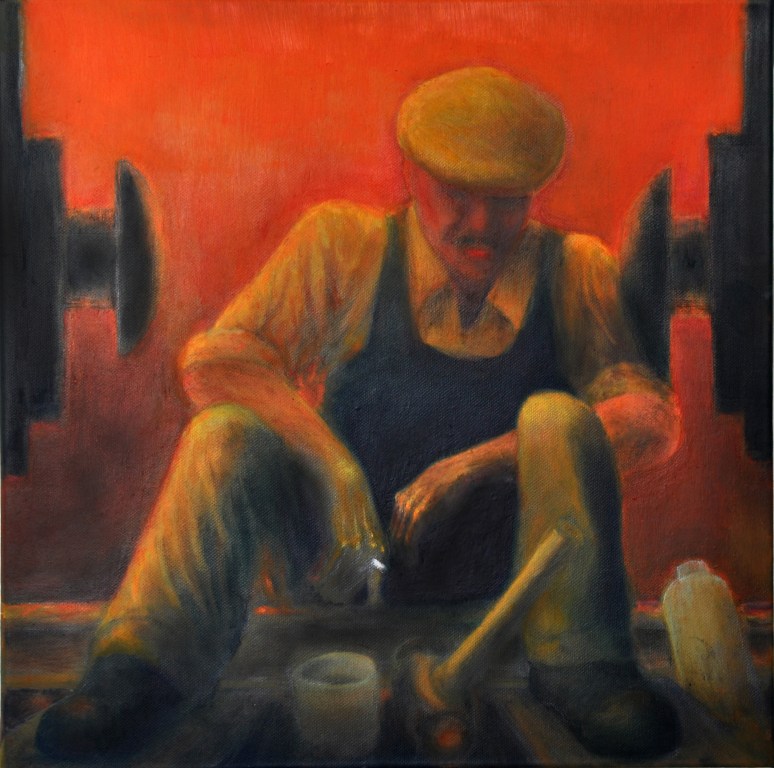
To add to the family income, and probably to keep up his hairdressing skills, he used to cut hair, on demand, in our back porch, and in Summer would go completely al-fresco, which helped keep the clippings out of the house. Another Llethry Road special-attraction. Men one shilling, boys sixpence, if I remember. The open door looked straight into Cae Beili Glas, with its long grass and cows.

The customers were mainly old friends and neighbours, contacts from the village such as Omri the butcher and his son. Even a local councillor. And a deacon or two. On summer Saturdays, there could be quite a queue past our kitchen , the front joining in the chat with the current customer and my father, the rest talking to my mother through the open window, or leaning idly into the field. On particularly balmy days, some of Lew Protheroe’s Friesan milk cows grazing in Cae Beili would wander over out of curiosity.
So far, so idyllic. Naturally the economical rates attracted gangs of loud hairy boys from the new estates in Felinfoel, who seriously tested my father’s patience, but no more than I did when he tried to cut my hair.
•••
Haymaking
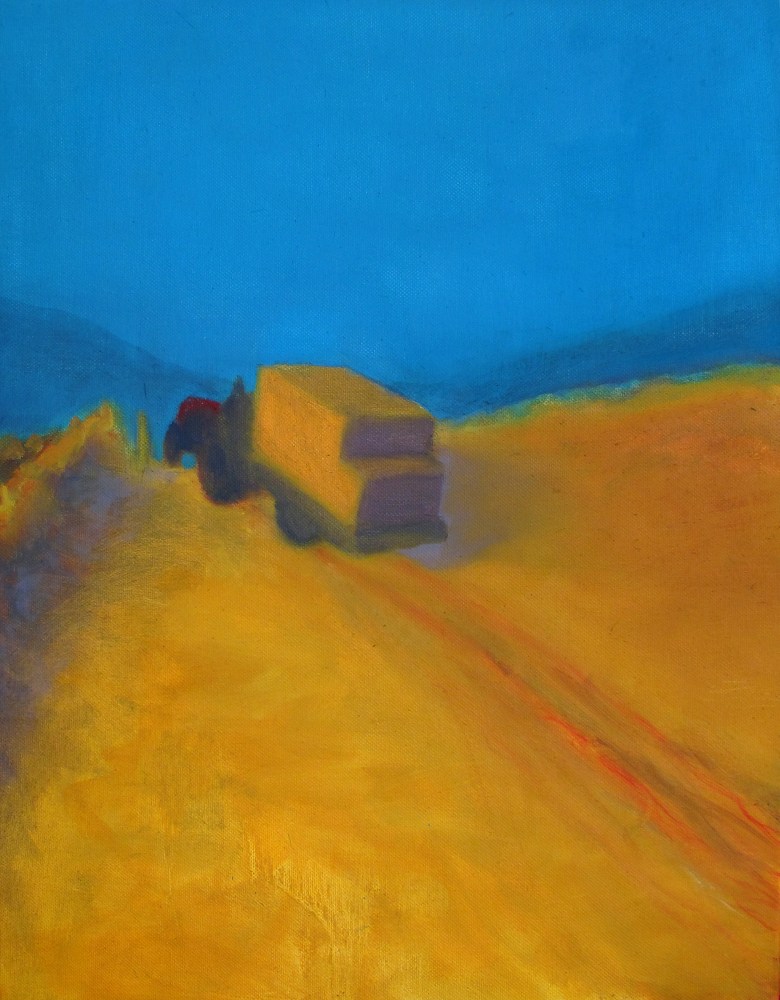
The prickly heat of the husks jabbing all over your body as you turned the hay before baling. Then the mad teenage competitive machismo of feeding the bales on the elevator as fast as possible. All in a golden haze of pollen and flies and butterflies and beetles and diesel fumes. That was the frenzy of haymaking.
And the deep Xmas pudding smell of the hay already beginning to ferment on the wagon as you rode on top of the last load under an unfairly wonderful immense universe, with the star-curtain lowering like snowflakes as the horizon went through blue to indigo to purple and black. Then stacking the barn to the rafters by the eerie shafts of tractor-light, with the hard fungus tang of last year’s bales being gradually drowned out by the sweetness of the new summer’s wild harvest.
Then later, the Barley. With the neighbour’s combine-harvester lumbering across the slope like a Baleen Whale harvesting Cryll – ambushed on all sides by gulls and ‘daws and starlings. The sterile straw bales were much more hypodermic than the hay.
Then the stubble-burning, with the late summer sun blasting its way through the blue smoke. And the mad scattering of the rabbits, and the squealing or exploding of the broiled frogs, their legs like teeny barbecued chicken drumsticks – once the dare had been taken. And much more delicious. And grown-up beer to wash them down – and proper cheese sandwiches on Mother’s Pride – real farmers being far too busy to bake their own bread, like in the stories.
Then the strawfights with tumbly farmers daughters – and then the buckets of water just to wake up out of the heat trance of dust and sunburn and teenage competitive labour. And home to sweat out the sunburn through the sticky night, to the sound of Pete Murray’s Top 20 on Radio Luxembourg.
Farms
Llethri Road was lined with farms and smallholdings. At the West end there was the original Westfa estate, which was split into Llandyri and Beili farms, then Blaen-Nant, Llethri Mawr, Syddyn, and Glyngwernen Isaf; with chicken farms Tegfynydd, Ty’r Itie, Pant-y-Ffynnon, Glyn-Celyn and Llethri-Fawr scattered in between. And looming over them all was Glyngwernen Uchaf – dominating the feeding-grounds beneath, just where an Iron Age hill fortress should have been once.
Interestingly, all but two of these farms had their footprints on the northern side of the road. That is, on the dry, uphill, South-facing ridge spanning the Lliedi/Dafen mini-delta. Perfect real estate for the canny Hunter-Gatherer to set up camp for the night, with breakfast on the doorstep.
The only exceptions being Llandyri, a recent farm with a beautiful post-war building ornamented with expensive red tiles – the slope of the hill meant that the front bedroom windows were at street level. And Pant-y-Ffynnon smallholding, which was another desperate land-grab sited immediately on the banks of the Graig, the little tributary of the Dafen as it meandered into the marshland. Both were swept away when Fisher & Ludlow bought all the land West of the Dafen to build a huge new factory pressing car body parts.
Until then, I had been free to roam almost anywhere – taking care to avoid irritable farmers, and I regarded it as my territory. Summer Sunday afternoons would find me meandering along the chaotic hedgerows of the lower fields, fascinated by their zinc watering troughs alive with Water-Boatmen and beetles in a little weightless world of their own. Laver-green cowpats sundried to crusty khaki. Bejewelled by bluebottles. Then on beyond the workable fields to the middle of the deep marshes, towards the bank of the Dafen, which was then still unshackled by concrete. There was generally a path to be found through the wet wilderness of the marsh, in spite of the increasing sogginess underfoot. The technique involved increasingly longer and lighter strides in search of relatively solid ground, then springing forward before sinking below fatal welly-filling depth. A fool’s errand obviously. A typical boy’s exercise of the imagination to defy gravity, like when we used to jump off the little bridge over the Dafen, and flap our wings to fly. It never worked. Our socks always came home soaked, and we knew that meant another scolding. But the regular challenge to navigate it gave us a unique mental map of the bog. Our comic-book explorers of the Amazon and Congo must have felt the same way, or at least started the same way.
After the fences went up, half my world disappeared under concrete and steel. Then half of the remaining half disappeared under housing for the factory workers, leaving only a compulsory fraction of the original Llethri Road where the Green Zone began.. From Glyn-Celyn Eastwards. The rest was now just like everywhere else. Even the spectacular and spooky Westfa House was eventually demolished for some reason. The fertile marsh between the Dafen and Lliedi was divided up between two vast car factories, and playing fields prone to flooding.
There was one place where the original Llethri Road marshland was visible until recently. ‘Pwll Clai’ was essentially a derelict opportunistic drift coal-mine from the 1930’s, dug into the climactic hill at the end of the road (Tyle Harris, or ‘Devil’s Hill’). I first remember it as a bare-scraped moonscape, exactly like a scene from the first Lone Ranger. The ambush scene in the canyon. The perfect playground – with a pond at one end on the clay base, and steep crumby shale cliffs which were just as dangerous as they looked. And a deep hole half way up the slope you weren’t supposed to go down. The site for regular bonfires with baked potatoes. My older brother remembers a riding the pond on a raft made of corrugated iron and oil-barrels.
But this scene rapidly changed as nature took over. At these times, the ‘pwll’ became a forest of reeds, buzzing with Dragonflies and swarming with small Mammals, Reptiles and Amphibians of all kinds which attracted a constant traffic of predatory birds, including Buzzards and Herons. Ash, Gorse, Broom, Hazels and Sycamores fringed the pond and dug their roots into the faces of the rocks. From harsh bare bones to flourishing mature ecosystem only took a few years the first time I saw it happen. The site was destroyed again in the 1970’s to provide hardcore for a the M4 spur nearby. Within 4 years it had completely regenerated itself.
Farmers
The farmers were generally not accommodating to little boys, for very good reasons. It didn’t help that most of them were on the other side of the religious and political divide of Felinfoel. They were tory C.o.E, or possibly Liberal in memory of Lloyd George, we were Labour and technically, Baptists. So our parents seldom met them, and their children tended to go to the cramped little Church of England school behind Trinity Church and next to the betting shop. The ‘Voluntary Primary’, as opposed to our ‘County Primary’.
Some might even have gone even to ‘Eglwys fach-y-Graig’ on Sundays, a miniature Anglican church built in the depths of the hills above Felinfoel, specifically for the benefit of the local farmers.
Rhydderch Braichfras David.
‘R.B.’ David looked the ideal cartoon farmer, from hat to boots, via bulging waistcoat and expressive walking stick. I was familiar with the farm after I had managed to make myself useful to his son and two daughters during a hay harvest when I was about 13. I had heard of ‘the Boss’, but we had never met. Then suddenly, one Sunday, he emerged from the house into the farmyard, an imposing figure who wanted to know who I was.. I was on his land, and I knew how farmers felt about intruders. I was on my guard, and gave him the equivalent of name, rank and serial number. He knew of me (everyone knew of everyone else.) But something else sparked his memory.
“You’re the one with that black dog.” I confirmed he was talking about Rex, the family cross-breed.
“I always shoot dogs on my land, and I’ve had yours in my sights more than once, and never shot him.
Want to know why?“
He told me that when I was 5 or 6, he would regularly see Rex keeping me as far from the road as possible. Acting as a natural, untrained guide-dog. It must have been the combination of Labrador and sheep-dog in him. After seeing that, R.B. could never shoot Rex, and could allow me to work on his farm, unpaid, of course. After that, we had a good relationship, especially when I realised that when translated from Welsh his name meant ‘Freedom Strong-arm’. Anyone with a name like that had to be interesting. Though maybe not as interesting or eccentric as the person who named him.
R.B. David was exceptional among the farmers of Llethri Road in having a University Education. HIs veterinary qualification led him into farming after the war, alongside the routine long-lost kinship with the landed county set. The Crachach. Many local farmers, smallholders, shopkeepers, and chapel deacons shared this belief in a lofty ancestry. Post-war milk subsidies also helped.
He would sit in the spare wobbly-floored kitchen of the farmhouse and pronounce grandly on the evils of socialism, the niceties of stock-rearing, the betrayal of Lloyd George, wearing his Wndsor armchair like a glove; or stand in the barley field, testing the heads between his thumb and middle finger, and calculating the best harvest time from the weather reports, which he got from listening religiously to The Archers. All farmers did. Once, when I dared to speak during an episode, the entire family of four responded with a single angry SHHHH!!
Like many of his generation he had been diagnosed with T.B. when young. And like many, his treatment was eccentric. In his case to drink the dew from a barrel of pitch every morning (something to do with the aromatic chemicals in pinewood.) He swore it worked.
My mother also had T.B. as a teenager. Her treatment in the sanatorium was to smoke Navy-Shag tobacco to ‘kill the germs’. She was taught how to roll cigarettes by fellow inmates, largely old colliers and sailors, and smoked all her life.“Amser i mwgyn bach.” she would announce after finishing the washing or baking.
Three brothers in the family next door to us all had T.B. in the 1940’s. They all somehow survived too. Tuberculosis was all the rage in the good old days before the Welfare State.
‘R.Bs’ education also led him to criticise standard local practices. He would rail against the traditional Welsh nursing shawl, which would ‘cwch‘ or ‘magad‘ the baby to the shape of the mother’s breast. He claimed it deformed the spine of the infant. Africans were much more advanced, carrying their babies on their backs.
He also favoured what amounted to Halal methods of butchery, claiming that the meat tasted better. Bleeding to death was less traumatic than conventional killing.
The farm catered for the Xmas turkey market, and the little flock was reared as organically and carefully as the rest of the stock. On the big day, they would be clucked into the freshly washed cowshed one by one. A rope was thrown over the low shed cross-beam. The bird was gently surprised, and its legs tied together. One of us quickly grabbed each wing while the bird was hoisted upside down, a long sharp knife inserted into its throat and its carotid artery cut. The death agony lasted some 30 seconds. Every flap of the wings more pathetic than the last until the eyes glazed in surrender.
I don’t remember the process looking less traumatic. Either for the turkey or his killers.
• • •
‘Dwr yn yr Afon, a’r Cerrig Yn Slip..’
I remember the simple lane, with its stream (the ‘Graig’) on one side as a fabulous green palace filled with nuts in autumn, with masses of bluebells in spring. We used to climb one of the big trees and sit in it for hours. Apparently, there used to be a woman who lived in one of the more modest cottages up there who appears in one census as a ‘pauper’ while her home appears in the Ordinance Survey map as a ‘hovel’. The overgrown footprint of more than one ‘hovel’ could be found among the trees. The ghosts of former homes. It wasn’t somewhere we went at night.
At the top of the tunnel of trees, and through the rusted black iron wicket gate on the old right of way, there were the brambles on one side and gorse on the other, and the path going straight up to Cribyn Farm – and the much more fascinating one dipping down and over the stream via two great gleaming flat stones, and up again to where the carpark opposite the community centre is now. Then it was just fields. But the real kick was from turning upstream into the huge great green, clean cathedral of Oak and Ash on either steep mossy ferny bank. Which is still there, only deprived for some municipal reason of its river, and so now has to make do with piles of fly-tipped rubbish.
It does seem obvious why the Baptist Revival was so popular hereabouts during the time when the temples of industrialisation were making many places was very black and smoky. I remember being very young and being carried/dragged by – I think – my sister and cousins across those stepping stones with the water splashing underneath, and assuming that this was the very stream from ‘Gi ceffyl bach, yn carrio ni’n dau.’ You know the bit: ‘Dwr yn yr afon, a’r cerrig yn slip..’ These were the very stones, my mother knew them, and was singing about them.
They were certainly ‘slip’. But I realise now that the technicolour dreamscape I remember was partly the result of looking at it in soft-focus. When I was about 6, my parents would nag me not to ‘squint’ at the TV. My brother would point to animals on our walks which I simply could not see. But I did see a mass of shifting coloured shapes which became real things for a while, then faded into mystery again. I think it’s probably fair to say this experience was ‘formative’. And hopefully, that these memories are not as sentimental as they sound.
At the age of 8, after the predictable diagnosis of Myopia (and tantrums) I began a lifetime relationship with corrective lenses (£1.10shillings NHS ‘Tortoiseshell’ steel-framed).
Needless to say I was stunned. Did the world really look like this? What were those blue things far away?’ ‘That’s the Gower…’ All the shimmering uncertainty was gone. My childhood was somehow different. There were hard, real things everywhere. It was a lost world which I vaguely remembered, but had been in denial of. Now it was back with a vengeance any time I wanted. The drawback was that I was now ‘Four-Eyes’ and ‘Gig-lamps’ for a while. But being large and confident enough for my age, that didn’t last long.
Bad in Bed
Shandy With Mary
Mary lived alone in a tiny, two bedroom cottage on the side of the hill. She was a widow, worked as a secretary in the radiator factory at the end of the road, and was bounteously-endowed enough to be often known as ‘Big M’, with fondness. Today she would qualify as ‘grossly obese’. Nobody had a bad word to say about Mary. and with good cause. She deserved her respect, earning it by simply being constantly cheerful and kind. A truly caring person in the Christian tradition.
It probably started as a form of baby-sitting, but between the ages of 6 and 10, I would regularly spend a few hours on Sunday afternoon drinking ‘shandy’ by Mary’s glowing blacklead range, eating Welshcakes, chatting, and playing Cheat or Pontoon. With the firelight glinting off Mary’s massive golden charm-bracelet through the smoke from her Kensitas king-size, and Mary’s golden chuckles glinting through our constant, outrageous bragging and showing off. Because what Mary really offered was not just the shandy-lure of a rural kids’ speakeasy, but attention, and the freedom to use it.
Those Sunday sessions were a sanctuary from the constant correction and nagging of school and family life. The usual babysitter tells stories to their charges. Mary didn’t tell us any stories, she let us tell her any outrageous lies we could imagine. But at least we were talking with a grown-up like a grown-up. The C18th Parisian salons could not have been more civilised, or more bathed by the smile of Reason.
Shandy with Mary was often part of our ’round’ of calls on adults who might invite us in for treats. My partner on these trips being my ‘minder’ of two years before, but now my ‘girlfriend’, the brunette tomboy neighbour Janet, whose brother Anthony ‘Poppy’ Hopkins had a motor bike, and whose Great Uncle (‘Edwin Fawr’) lived in a giant black corrugated shed in a field with a grandfather clock, the universal blacklead range, and his giant shock of John-Brown glory-halleluyah white hair. (See above)
When I first knew her, Mary was only in her mid-20’s. Her cottage had no plumbing as such, and on Thursday nights, she would come to us for a bath. There was at least a sizeable wash-house, and a full-size tin bath. So my first memory of her is probably of her at her pinkest, emerging in a cloud of steam from our washhouse like a vast Welsh Venus from the waves, in a vast white dressing gown, to dry her hair before the open Rayburn.
We were hi-tech in our house. We bought a 2nd hand Rayburn just after the war and sold the range for scrap. Mary’s husband Phil had tried to upgrade their new home about the same time, doing the building work himself. Their cottage was number 2 in a row of 6 rubble-built labourer’s cottages raised in the mid C19th on the Westfa Estate of Charles Nevill.. The walls bulged with generations of whitewash. There was no rear access to Mary’s except via a narrow track alongside number 1, owned by Morle Morris, who wrongly claimed total control over the track.
One night Phil was removing a wheelbarrow of rubble for disposal at the bottom of the hill. Morle took his shotgun and killed him without warning.
I found out about it the same night. I was just old enough to understand when my teenage cousin turned up at our house in floods of tears and told my sister the news.
Morle was sentenced to an indefinite term in Broadmoor.
Mary didn’t get her bathroom until much later.
She never got the gratitude she deserved from me for all her kindnesses. But she never, ever expected any. Her adoration of childhood was completely unconditional. The rigid conventions we were usually subjected to were not needed.
Snow 1962/3
Boxing Days were normally interesting enough, but when I opened the back door and was faced with a wall of snow above my head, moulded to the shape of the carpentry, all other Boxing Days faded into insignificance.
Within minutes I was out in Cae Beili Glas next to the house, and soon there were a crowd of us doing snowy things while our parents tutted in the background wondering what the world was coming to.
Corrugated iron sheets and tea trays and other improvised sledges were dragged out, and the snowballs flew like pigeons.
The boys soon decided that a walk was called for. Like one of our rambling summer walks with dogs and sandwiches, only up to our knees in snow. It was a boy’s dream come true.
Passing down the road into the village, the sight of more than a foot of snow covering everything was a beginning. At our age, we’d never seen anything like it before, and we would have been satisfied with that. Then we reached the Lliedi, and began to realise the scale of the event. Apart from a little channel running down the middle, it was iced over, and there were genuine Walt Disney icicles from the branches of all the trees. The waterfall into the Lliedi was a pipe of glass channelling water raggedly down through the trees. It was fascinating enough in its usual state. Now it was beyond description. We threw stones at it and brought it crashing down.
Threading our way up the valley one spiky wonder followed another. The constant virgin fluffiness of the pure white drifts. The ecstatic flights of fancy of the clutching ice-fingers frozen in time at the ends of branches, or on the green holly leaves, or draped around the arches of brickwork, or exaggerating the barbed wire fences.
We hit the Mynydd Mawr railway and took in the village below, drowned and invisible under the fallen and falling snow. The railway was covered in drifts and we ploughed through like Polar Explorers eating banana sandwiches, tripping over the smothered sleepers. The dogs were even more excited than we were, and missed no chance to wallow in the meringue, and would suddenly jump in the air from surprise or doggy delight. Alongside our furrow were dozens of tracks of birds and rabbits, and other hungry pawprints.
The deep, blasted railway gorge came into view round the corner, and when we realised what had happened to it, we broke into a stumbling trot. Everything before had been leading up to this. We should have expected it, given what we’d seen, but couldn’t have foreseen the kind of mad winter wonderland which surrounded us.
Again, this place was gothic and glorious enough in its usual grey damp weather, with its ferns and hawthorns and sycamore clinging to the bare rocks. But now it was like nothing on earth. Like something from the Ice Fortress of Ming The Merciless, or a Disney extravaganza, or what happens when god takes the day off and leaves winter to a 11 year old boy.
Great curtains of ice hung from crag to crag, glistening in the afternoon light. Ten foot icicles with their sons and daughters layered the rock face, with more families of ice on top of them, and soggy stalagmite icicles on the ground to harness any water which had escaped the initial freeze. There were the gargoyles of leering ice faces and animals everywhere.
After gasping in amazement for however long it was, we scrabbled the granite hardcore from between the rails, and let loose, destroying as much of this glorious creation as we possibly could.
The walk down through the forestry to Swiss Valley reservoir was the most Xmas card experience any of us had ever had, or probably ever will. The towering pines and spruces with sheaths of snow thudding from them in the otherwise utterly silent woods.
And then we saw the reservoir itself, which was totally frozen over. It was so frozen that the weight of the ice had caused the surface layer to collapse under its own weight to a depth of about 6 foot, creating a huge ice basin, or collapsed pie crust. We could see how thick the ice was at the edge, and decided that this was too good a chance to miss out. We slid into the basin, and began an afternoon of hectic sliding and scurrying until we dripped with sweat and our face-scarves had curtains of icicles on them.
Slowly, we began to realise that the sun was going down and that we were getting cold and hungry and should think about going home. We then realised quite quickly that sliding down into a frozen reservoir was a lot easier than sliding back up.
The general approach was the long run and desperate clutching slide. Eventually, one of us made it, and was able to offer a hand to the next person, and so on until we got to the dogs, who were totally stymied, and who could only do a sort of hilarious cartoon running on the spot. They had to be physically hurled up the slope by the last boy, who was grasped by the rest after a last desperate charge.
It took a long hungry, cold time to get home, but the long slide down the still frozen Swiss Valley Hill helped. The snow continued for another two weeks, and we didn’t go to school for ages. The death rate among the old and frail must have enormous. And everywhere more than a mile down Llethri Road was cut off for days.
1962/3 Statistics
•••
Felinfoel County Primary School
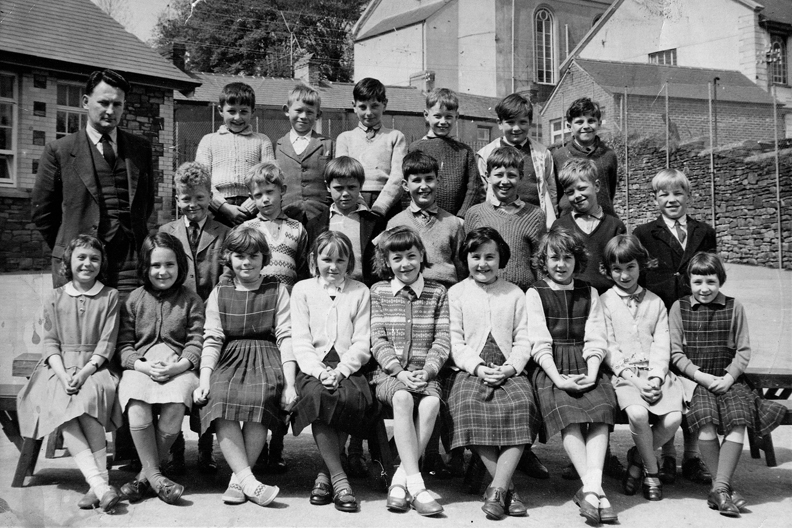
Standard 3E. Felinfoel County Primary School. 1962. Master Mr John Williams.
Back row L>R
Noel Rees. John Armstrong. Vincent Bush. Robert Bartlett. Phillip Williams. Barry Brooks.
Middle row L>R
Gareth Roberts. Douglas Jones. Stephen Evans. Robert James. Robert Kenyon. Haydn Beynon. Desmond Butler.
Front row L>R
Maria Edmunds. Gwynneth… Karen Davies. Ceridwen Price. Melita Hopkins. Gaynor Lemon. Elizabeth Norris. Susan ….
Master: Mr John Williams.
We all came here aged seven. No longer fuzzy with astonishment at being alive.
Ysgol Y Babanod, our infant school was, in fact, space-age new. Looking back, it was like something out of Tomorrow’s World. It was a shining example of 50’s modern architecture, and still is, though we didn’t know that then, and most still don’t. It had a massive parquet hall, where the beautiful Miss Parkinson, our headmistress, would play the piano with the sunbeams from the wall-high windows lighting her hair. She made all the boys fall in love with her.
By my last year at infant school, I was somehow trusted to escort Anne Protheroe, the daughter of Llandyri farm opposite, morning and afternoon. I don’t remember losing her. My reward was an extra breakfast, a Sailor on a Raft (poached egg on toast). The route of a morning ran down Llethri Road, past the ‘cwm’ downhill and the ‘new houses’ (Bryn-y-Felin} on the right. Then the vast Westfa Ghost House, looming through its forest of huge oaks, with the ‘Morris Motors’ factory opposite, behind a row of snazzy postwar bus shelters.
When we reached the junction to Felinfoel Road and saw the old stone water mill, we turned down the hill, past Sion Nan, and The White Lion, then immediately left down Park Vie, with the little village bookmaker’s, and past the Church School. Made of stone, crammed behind stone walls with iron railings, and opposite another stone wall of Trinity Church, with its intimidating spire.
Felinfoel CP was a step back in history for us. Our desks must have been 60 years old and had been sat on by some of our parents and even grandparents. Unlike the Modernist tubular steel and plywood creations at Ysgol y Babanod, they were gnarled, oaken and ink-stained, and held together with curved black cast-iron. They looked like they were made by the same company which forged the black open-hearth stoves some of us still had at home. Or the bridges that spanned the railways to the collieries. There was something grim and grown-up about them, compared with the innocent post-war optimism of our gleaming infant worksurfaces.
The school was made of stone and red brick and brown tiles wood and more cast iron. There was a radio, which was bakelite. But nothing else electrical other than the lights, and the kettle in one or two of the classrooms for the teachers’ tea.
Singing
We soon discovered that the entire week at Felinfoel County Primary used to revolve around singing. There was a hymn to begin and end the day. On Mondays there was‘Singing Together’, the BBC radio singalong session, instilling for life old favourites like ‘John Peel’, ‘Widdicombe Fair’, ‘Men of Harlech’ and ‘Hearts of Oak’.
On Thursday, there was the dreaded ‘rehearsal’ for the Friday ‘assembly’ in the formidable Miss Walters’ class. This was a serious trial. For an hour and a half, the entire school would stand in rows, youngest at the front, oldest at the back, and repeat the forthcoming Friday’s programme of hymns until Miss (Fatty) Walters, or Miss Thomas or Mr Williams or the ghoulish Mr Morgan was satisfied. Children would be beaten for being late on the beat, humiliated for having no tone, and screamed at for singing too loud – which I never thought fair even at 9 years old. In the winter, people standing too near the coal fire would faint, or throw up.
Concerts
The year had two musical highlights. The eisteddfod on St David’s Day in the packed Festri Hall of Adulam, and the Christmas Carol Concert in the full glory of the chapel itself, where the boys all wore white shirts and red ties.
At the eisteddfod, the girls would promenade in full Welsh dress and daffodils, while the boys saw the whole thing as a Prize Leek competition. During the parade of little earnest songs, poems and dances, to which we paid no attention at all, the air filled with the stench of chewed leek, until by the end, the windows would have to be opened, and heads smacked.
The Christmas concert was the real chance to show off, being in front of the entire village (or so it felt) in the big chapel. Our ‘choir’ sat in the gallery, and ran through the early part of the programme obediently enough. But near the climax, after the ‘Silent Nights’ and other soppinesses came something more rousing, I forget what, and instantly the budding juvenile delinquents (in our red ties) slipped into full rugby crowd voice, and one teacher at least held her head in her hands. But I couldn’t help noticing that more than one of the grownups looking up at us was smiling broadly.
All of which was a preparation for the amount of public singing which still happened then, no doubt this was a habit retained from the war.
No coach-trip was complete without a chorus of ‘He Jumped from 20,000 feet without a Parachute..”.. (‘They scraped him off the tarmac like a lump of strawberry jam’). Or ‘Did you ever See such a Funny Thing Before?’ Just to pass the time. ‘Roll me Over in the Clover’ was a little confusing to a decent 8 year old Baptist boy. Confusing but interesting.
Complete strangers sang the old popular anthems and folksongs together at parties and on public transport.
Playtimes
My first playtime in Felinfoel C.P. was in September 1959. My first memory of the space was of exploring the narrow ridge which snaked at room-floor level around the craggy stone structure, turning it into a perilous Alpine cliff-edge. The game was to shuffle along without falling off.
Almost my second memory is of hearing the name ‘Benny!’ being called, and turning to see an older boy flying up the cramped slopey playground as if on wings. Even at that age we knew there was a genius in our midst. I know, because ‘I was there’.
Like most village schools of the time, the playgrounds were segregated between Boys and Girls. The Girls’ yard was much smaller than ours, but had flushing toilets. We didn’t mind. We certainly didn’t miss competing for space with skipping. Which of course was ‘soppy’. Boys played rough games. Like the homicidal ‘Best in Dying’. One boy was selected as ‘gunner’, to defend a chosen point. The rest ‘stormed’ the gun-point, dying as theatrically as possible. The Gunner chose the Winner, who then became the Gunner. It was a game vulnerable to corruption. I’ve never heard of it since.
Girls played intricate rhythmic games requiring intense coordination of mind and body, juggling the dance of the rope with improvising the lyrics of the accompanying rhymes – I realise now. We dismissed this skill as an example of mere feminine delicacy, like their seemingly natural ability to crochet, play musical instruments, and invent a pig-language which boys could not understand
If I had joined in, I might have been better at Maths. Or even been able to play the piano – a bit. There was the occasional corner of boys researching the Holy Trinity odds of Rock-Paper-Scissors (‘Izzy-Azzy-Oo’), but nothing more mathematical.
School Trips
TBC
Going Home Time
The most vivid memory is of the mad stampede for our sugar-fix from Freddie Tripp’s little sweetshop next to the school. From the centre of his Multicoloured Cave of Candy, he frantically dealt with the crazed mob baying for Spanish Root, Sherbet Lemons, Black Jacks, Flying Saucers and a hundred other recipes for instant kiddie-comfort.
Adorable 8-year old madames fighting their way to the front with Lovehearts burning in their eyes. Then squatting ferally by the stone wall, to watchfully cram them in a mouth half-hidden by golden curls. This was when a bar of Fry’s Chocolate Cream sold for fourpence.
The swaggering 10 year-old boy of the ‘top class’, day-old Spanish Root roguishly in the corner of his mouth, spits through likerish-stained teeth. Pulls his socks up beyond his knees as far as possible, cloaks himself with his Pacamac, and flies home to his fortress of solitude for Shepherds’ Pie, if it was a Monday..
Then there were flavoured crisps. A taste revolution. The new decade had begun with a crunch.
The trip home often became a miniature ramble, squeezed in before the inevitable Teatime. The Lliedi ran nearby, with its baptismal pool, and was a natural attraction in all seasons.
However, going home was not all dilly-dallying through the Dewdrops. Felinfoel was not an idyllic unified pastoral hamlet. Older boys from the Church School lay in wait to terrorise unwary strays from The County School, and even from Ysgol y Babanod – the path from which to Llethri road ran past the gates of the Church School and against the forbidding stone wall of the church. There was no escape. It was often safer to take the long route home via the bridge downstream.
Sometimes that didn’t work. Somehow, three of us were rounded up and tormented by four or five much bigger older and nastier boys. The same boys who used to stamp on birds nests and blow up frogs with bicycle pumps.
We were aged about 8. The torture consisted of bloodcurdling threats and extreme Chinese burns. Long, detailed descriptions delivered with sadistic relish. The message was clear, we were not going home alive. Two of us were just young enough to believe them, including me. I genuinely thought my time had come, but the youngest lad was totally hysterical and inconsolable. His reaction was possibly even more disturbing than the threats of the bullies. And the entire experience was made totally bizarre by being conducted in the open centre of Felinfoel, astride the giant water-pipe crossing the Lliedi. Locals went about their business on the road alongside, stopping to chat outside the White Lion, the Bear or the church, like an episode of Trumpton, totally oblivious to the group torture on the pictureseque riverside grassy knoll, almost within earshot. A bunch of boys. Nothing to see here. No harm done.
Spare the Rod
Felinfoel County Primary School between the years 1959-63 definitely still used some Victorian educational methods. Children were intimidated and punished for mistakes in their work, not merely to maintain order in class.
I would feel the dreaded Mr Tayson glowering over me while I tried to untangle some weird problem in Arithmetic, until the numbers would get jumbled, and I would have to make an answer up in desperation. Then he would explode, as I knew he would.
He was the same during ‘Penmanship’. Ink-stained ruler in hand, punishing every uncrossed ‘t’ and undotted ‘i’. As a result, my handwriting is appalling and my Maths skills were effectively paralysed at the age of 9. I would class that as ‘child-abuse’ in its way.
The pupils’ experience at Felinfoel CP depended largely on the age and attitude of the form teacher. Teachers like John Williams and ‘Wilf’ Rees, were generally respected, and did not depend on fear. Their lessons were definitely more memorable than best forgotten. Mr Williams weekly history lessons were hypnotising, with their simple stories of ancient Wales and the ‘Beaker People’ which I later discovered were based on the most recent archeological discoveries. Wilf Rees loved to read to the class, one day performing every character in Alice in Wonderland.
Wilf delivered the Dodo’s line from the Caucus Race as a pompous old idiot in a posh English accent:
“All have won, and all must have prizes”.
But instead of reading straight on from the book, he improvised a reaction from the excited crowd: ‘Prizes! Prizes! Prizes!’ – in pure broad phonetic Llanelly.
The contrast of characters was delicious and brought the house down. We didn’t stop laughing for minutes. We heard our voices squealing for ‘Prizes! Prizes! Prizes!’ He was making fun of us, and we loved it.
That was a big day for education.
Additions from fellow alumni.
“I remember being at the whip end of the chain and my head hitting the wall under to Freddy Tripp’s shop, that could be why I can’t recall the name of the game.
I remember the crates of frozen milk with ice-cream like growths under silver caps, standing by the big Cast Iron burner in Mr Rees’s classroom, and unfortunately can still taste the milk we had to drink after it defrosted, yeuch!
I remember taking the dares to climb over the wall into the Girls’ Playground and running around while the girls screamed for Wales.
I remember Tyson caning me and you (?) with his hazel switch. We had tried to be clever and snatched our hands away the first time. I remember that “Oh So Brief” feeling of relief that he had missed our palm up hands on the down stroke, far too quickly followed by the agony of the blow on the back of my fingers on the upstroke, I’m sure he’d be arrested now!
I remember the contests in the Boys’ toilets to see which one of us could send a piss stream from one end of the toilet to the other, by holding the end to allow a build up of pressure. I remember the girls looking over the wall from their playground to see which boy won.
I remember Kathy Groves from the year below us and carrying her books home from school far too regularly, (I also remember snatching a kiss from her and running away in embarrassment!)
I remember the ambidextrous Mr Evans in the Welsh Class writing on the blackboard with two hands.”
Gareth Roberts (pictured above)
“I had Mr Evans after Fatty Walters. He had a hearing aid and glasses I seem to remember. I’m not sure whether it was one or two years with old Fatty. I remember she has spittle drooling out of the corners of her mouth and when agitated (i.e. often) it used to run down even more and she had to dab it off with a hanky. She also used to sweat a lot and had a smell that a dog would be proud of.”
Gary Jones (contemporary in the Welsh Class)
It is interesting that Gary is vague about his period under Miss Walters. My memory is that she taught the first two classes in the same room at the same time. Another echo of the Victorian Dame School in the late C20th. There must have been 40 children in the room, ranging wildly in age and ability. My older brother claims that she used to lock children in cupboards in his day, (1945-48)
‘Graduation’
By some miracle, all my Felinfoel C.P. term reports from December 1959 – August 1963 have survived almost intact. The absences are interesting as they probably reflect Flu epidemics and hospital holidays as much as my chronic laziness (“Mam I got a bad belly, honest.”).
The relatively small sizes of my class can be partly explained by the fact that the school was divided into Welsh and English-speaking classes. However, this doesn’t explain why some teachers, like Miss Walters, taught years one and two in the same room at the same time. (1W & 2W)
For some reason, our year escaped that experience.
Ultimately the dreaded Eleven Plus loomed over us, and scared some of us into action, especially when hearing horror stories of the alternative, Coleshill Secondary Modern, from older brothers of friends trying to frighten me. They did. But some in our class with brothers who had ‘failed’ the Eleven Plus were far more relaxed. They had brothers waiting to protect them and seemed to have a grasp of the purpose of ‘Secondary’ school system, which was to supposed train future tradesmen and engineers, which they wanted to be. They did not want to be ‘Grammar Snobs’ or go to University. Neither did I. But I didn’t mind going if I felt like it at the time. Naturally I would choose to go to Oxford because I preferred their boat-race colours.
During my four years at Felinfoel CP, the world experienced the Cuban Missile Crisis, The assassination of J.F. Kennedy, The launch of Telstar, and the worst winter of the century. The world of ‘DRINKA PINTA MILKA DAY‘, Babycham, not being able to stay awake long enough for The Goons or ‘Quatermass’, wearing shorts in Winter, and having agonising growing pains at bus-stops.
And then suddenly one wonderful world-changing Summer – The Beatles…
I visited the school one more time in 1970, with a friend about to do a Teacher training course. The new headmaster told me how horrified he had been at seeing the state of the toilets. I had no excuses, and could only mumble “We managed”. The rest of the school was much the same. The same vintage desks, lavish ceramics and high windows. The dinner was better.
A few years later this excellent example of Victorian community architecture was bulldozed to dust.
‘Holidays’
bogarde/cubs belt/black boy/underwater/knickbocker glory/
•••
Big Cousin
It’s a sunny day in 1956 or 7, and tall, dark, well-dressed young man is walking up a flight of stony steps from the Mynydd Mawr railway with a little 4 or 5 year old noisy boy trotting at his heels. Every question is answered quietly and patiently, but the boy keeps on badgering and showing off and falling into ditches and stinging nettles whenever possible, and generally earning the babysitter his fee – not that he is paid any, being his cousin.
They get to their destination. A dark little corrugated iron shed next to the Municipal Filter Beds, where the man’s father is having his dinner. There is a striking family resemblance, except that the parent is much sterner and intimidating to the boy – his great nephew – who is now much quieter as the Uncle and his workmates eat their sandwiches and smoke their pipes and cigarettes to the background scent of the purifying sewerage
The couple carry on with their walk. Down down through the pinewoods to the side of the reservoir to skim stones across the sunflecked water until it’s time to go.
This is almost the boy’s first taste of the world and of not being treated like a baby. Of being introduced to the sights and sounds and smells of things outside the prison of a pram. And in his big, handsome, patient cousin he has the perfect guide, and will remember the experience for the rest of his life. Almost every surviving hedge and tree and pub and riverbank within walking distance of the Noisy Boy’s house has a sunny memory of his big cousin imprinted on it like a seal of authenticity. And every time he sees Dambusters on TV 50 years on, he will remember seeing it for the first time in the glittering cinema dark with his big cousin. He wiill remember being gently told not to shoot everyone in the Odeon when watching the B-westerns; and the incredible trip to see an ‘A’ Certificate – ‘Hell Drivers’ with Sean Connery and a host of British stars. The sign outside actually dared to say HELL, a word not allowed in the respectable world. A word which once caused tightly-corsetted ladies to faint at the horrifying visions of eternal torment triggered by the mere word. It invited in the Devil.
– And always remember the Firestation Xmas parties and the presents made by the hero-firemen – even though he never did win the fort – which every boy coveted.
And never forget the trips to Felinfoel Brewery to fetch cheesy slabs of yeast for home-baking, stored in square holes in the white walls of the vaults housing the huge vats of fermenting beer, foaming with suds a foot deep. The fragrance was so overpowering it had to be waded through. The river smelt and foamed the same downstream for half a mile.
– Or watching the farriers opposite the Brewery fettling a gigantic dray horse, in a shower of red-hot sparks and clouds of choking hoof-smoke, on the forge open to the kerb at the historic Union Inn.
He will never forget these moments because they were shared, and because they felt like freedom. For those afternoons, the Big Cousin’s role was to make good memories, whether he knew it or not. Many other adults on Llethri Road made similar nameless contributions, in the spirit of the traditional African proverb that ‘It takes village to raise a child.’
Summer Jobs
[watch this space]
TO BE CONTINUED...
‘We Come Along on Saturday Morning.’
Or as we used to sing at the tops of our voices:
‘We come along on Saturday morning
Greeting everybody with a smile.
We come along on Saturday morning
Knowing it’s well worth while.
As members of The Odeon Club we all intend to be
Good citizens when we grow up and Champions of the Free!
We come along on Saturday morning
Greeting everybody with a smile.
Smile!
Smile!!
Greeting everybody with a smile.‘
And then settle down to a morning of combined cowboys and horseplay and tribal score-settling. The crew from Copperworks and New Dock always vastly out-muscled any mob we could muster. And Felinfoel was itself a divided force anyway, so there was no real hope but camouflage for the few of us who used to make the trip from Llethri Road.
After the anthem of the Odeon Saturday Cinema club, the programme began. Cartoons, comedy short, serial, feature. Popeye, Woody Woodpecker or Loony Tunes; Three Stooges, Laurel & Hardy; Roy Rogers, Gene Autrey or Buck Rogers; British or Canadian Film Foundation black and white or Disney colour melodrama. Often involving a dog. Everything flickering through a storm of chatter and fighting and shouts at the movie and at opponents above, behind and in front, all bombarding each other with missiles of some kind, especially in ‘the talking’. ‘What was the picture like?’ – ‘All talking..’.
We survived. And if we were careful, we could hide until the first matinee started, watch it for free, and stagger out into the mid-afternoon blinking like owls.
The Odeon in Llanelli was the grandest of the cinemas, but I haunted them all. The greatest binge of all was the Hippodrome’s cheap summer season of 1962. Someone at ‘Hagger’s’ had got a bulk deal and was putting on four double bills a week, changing on Wednesdays. Including my regular Saturday movie, I must has seen over twenty movies in four weeks.
Down Town
The library was an important bit of the childhood Saturday in the industrial Welsh past, at one time. Along with the Odeon in the morning, then rissole and chips at the Savoy, then Frost’s comic and toy stall on the market, and Hodges’ model shop in Market Street with its spitfires, and model aeroplane ‘dope’. The incredibly opulent sports shop in Stepney Street with its arrows, fishing rods, footballs and shotguns with their gleaming walnut stocks. And its high wooden racks and display cases and counters. Apart from being a train driver or fireman or spy or fighter pilot or outside half for Wales, or Davy Crockett, being a shop assistant among such wonders would have been one dream career.
•••

For a particular kind of Llanelli teenage bargain-book-hunter, there was the ‘Refugee Aid’ bookshop in Llanelly House, the decaying C18th architectural masterpiece at the heart of the old town. This book cave stank so much of mildew you could almost see the spores drifting through the air like pipe smoke in a pirate tavern, and the two little old ladies knitting among a pile of damp cardboard boxes might have been its blousy barmaids. They might also have been sitting in a psychedelic haze, if modern research into book-dust is to be believed.
Which particular refugees we were aiding by buying one book for every three we stole, we never knew.
There were strange and expensive books there which must have come from defunct country house libraries and middle class Great Depression bankruptcies. The story of the book was as much in its appearance and smell as in the words. Great rusting tomes of Carlyle’s pernicious and unreadable essays, church editions of The Pilgrim’s Progress, with brass corners and Sunday school lesson plans in a special appendix. History was very near in those books even if the original homes of the books were beyond my experience. But so were copies of the mad, banned Beat poets and Williams Burroughs from god knows what trendy Llanelli avant-garde cellarites. Here was another Llanelli I knew just as little about.
The imposing stone battlements of the Victorian town library opposite were quite different.

Since I was little, my father had taken me with him to replenish his weekly ration of Zane Gray westerns, and I’d got used to the place. And rather liked its grown up waxy meaty smell of stout leather municipal bindings and polished wood shelves. I liked the high top-lit ceiling with its pigeons and, when I was only 8, the fact that I could go in to a huge stone building, and take away expensive books, and that the adults around weren’t trying to stop me, but were actually at my beck and call.
But most of all, I liked the grown-up feeling of imitating my father. That is what most instilled a lasting interest in books, not being read to or inspired by enlightened teachers. There weren’t many books in the house apart from the usual religious texts and a few self-help books and technical volumes from my father’s Depression era attempts at self-improvement. He had no literary interest as such. I suspect the Zane Grays were a side-effect of his military service in Europe. Escapist fiction to dispel boredom and numb the senses to the horrors he never spoke of. However, there were a few inherited classics which I waded into, as much for show as anything else, and found that in spite of not knowing all the words, I was fascinated by the world they created.
I definitely liked the record library when I was older, and heard things courtesy of the Llanelli ratepayer, with a dash of teenage random dumb luck choice, which I might never have heard otherwise, and which have served me very well down the years. Likewise the books. And all partly made possible by the subscriptions of people who worked so hard they seldom had time or energy to read a book themselves, and who would probably not live to see much return on their investment.
Stradey

Then off to the rugby for a 3 o’clock kick off against Neath or Richmond or Cross Keys, to watch the brilliant Phil Bennett do things with space and time and a rugby ball which have never been seen since, and which he seldom approached in his televised career.
After attempting to imitate him through the exiting multitudes in the cinder car-park, it would be home along the Mynydd Mawr railway, following the pathway trodden by generations of workers from the steelworks by the coast to the mines inland.
See more at
Industrial Rugby
Studio Nan / Real Nan
I was asked to scan in this image of a client’s grandmother, taken as a remembrance on the eve of her daughter’s emigration to Britain from the West Indies. The client mentioned that the photo (left) did no justice to her grandmother’s personality, a failing which is clearly a combination of haste and negligence on the part of the photographer. Together, we undid the damage and converted formidable, stern Nan into the one she remembered.
The question was, ‘Is this how you remember your grandmother?’ The next question is therefore whether to adjust it to be more faithful to the memory of the sitter is to be unfaithful to historical truth.
Does emotional truth take precedence over the chemical record of the moment, snatched briefly without any sympathy with the sitter, or much real consideration of the needs of the target audience for the photograph?
The slight rotation of the head, plus ‘smearing’ of the edges of the mouth with Photoshop make the photographed Nan more like the real Nan, according to her grand-daughter. Which reality is truer?
First Impressions Do Count
I realised recently that two of the images which have had most influence on me as a photographer are two of the first I ever saw, and I don’t even know who took the photographs.
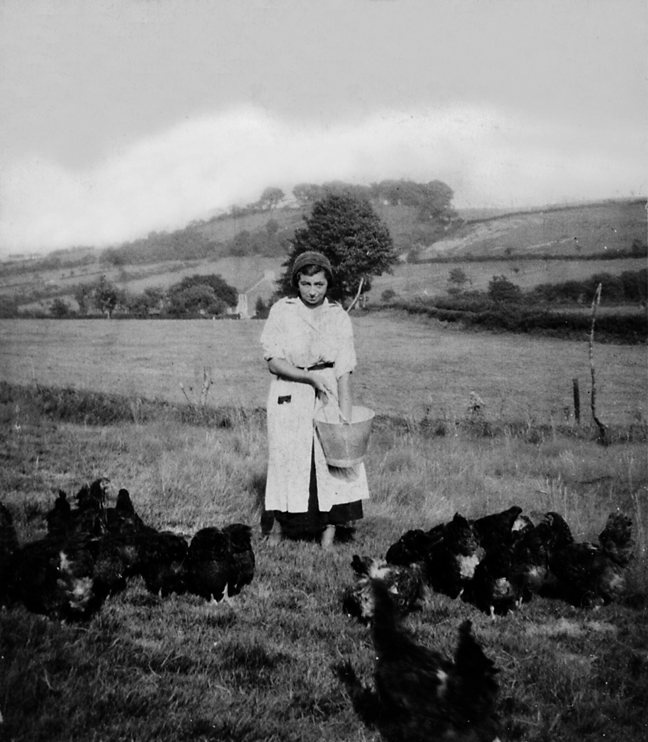
This simple composition of my mother at work has always fascinated me for its clarity and for its respect of the ordinary. It provides all the information we need and lets us draw our own conclusions. And for this kind of family snapshot, is remarkable for being both un-posed and spontaneous.

This image of my sister and a friend taught me the basics of the action shot, including the importance of background and context to add interest, ask questions, and tell a story.
Rodchenko, Cartier-Bresson, Klein and McCullin and the rest came along later and overshadowed these early influences. But essentially, I am still taking the same two pictures, for better or worse.
-

counter 14/5/2013
 biginabox